Showing posts with label Results. Show all posts

Tuesday, 16 August 2011

Increase Sales by Leveraging Down Economic Times to Build Your Business Results


Are you thinking that the economy is terrible and sales are going to the dogs? Guess what? Many of your competitors are thinking this exact thought or something very similar. Did you know that down times are the best time to increase sales not to mention to improve your own sales skills.

Of course, by taking this attitude means that you will need a plan of action by knowing your existing sales statistics. Small Business Sales Coaching Tip: : Do not confuse motion with progress and activity with results as a close friend of mine has often stated.


What are you sales numbers or sales stats?
Do you know how many dial ups you need before you can reach someone?
Do you know how many people you reach to secure an appointment?
Do you know how many appointments turn into requests for presentations?
Do you know how many presentations actually convert into earned business?
Do you know the sales value of your customers?
Do you know your average sale?
Do you know how much time was required to earn the sale?

Small Business Sales Coaching Tip: If you answered No to any of these questions, you need to reread the previous coaching tip. Also, it helps to calculate your numbers based on 100 call ups or contacts.

Why so many professional sales people give up during down economic times is that they do not know their sales numbers. This ignorance is a killer and probably stops most sales professionals from reaching their goals to increase sales. Small Business Sales Coaching Tip: Knowing your numbers is part of your sales skills.

There is an old adage if "you cannot measure it you cannot manage it." When you consistently measure your actions, you can track your results.

For example, I know that every time I speak, I secure one client within 6 months. The average value of the client ranges depending upon the needs of the client. However, if I want to increase sales, then I need to increase speaking engagements.

Years ago, I constructed a simple business model, MSP, that helps to keep my focus on my sales numbers and consequently sales skills. For example, a speaking engagement is a Marketing activity. This specific action for me generates one Sale at XX Dollars. If I want to increase my income (Profits), then I must increase the number of speaking engagements. When you understand and more importantly use your sales statistics, you will not only increase skills, but probably improve your own sales skills.


Take this free sales skills assessment to help you increase sales.

Is your business facing inconsistent or insufficient cash flow, lackluster sales to poor productivity? Maybe some exercise at the sales coaching training gym will get you to where you want to go?

Leanne Hoagland-Smith, Chicago Sales Coach, helps small business owners to C Level executives from Chicago to Indianapolis to worldwide who are truly tired of struggling to unlock the sales and business results that they want. Call 219.759.5601 to schedule a free business coaching training or sales coaching strategy session to begin to quickly unlock tomorrow's solutions today.


This post was made using the Auto Blogging Software from WebMagnates.org This line will not appear when posts are made after activating the software to full version.

Sunday, 14 August 2011

How Repetition Will Help You To Explode Your Sales Results


Something happened to me the other day that could help you to increase your sales performance rapidly...

Last week I went out for a meal with some friends and one of them had brought along someone whom I had not met before. This person was in IT sales. They were in their mid to late twenties and had been doing it for about 3 years. Judging by their conversation, description of their job and a few other factors I guessed they were doing ok... comfortable in their job but no sales superstar.

He had no idea that I was into sales training or was a sales motivational speaker and during the meal we talked about various things but towards the end of the meal this chap (let's call him Pete) mentioned that he was a bit bored of his job. He is finding it "so so". He explained that he has to keep doing the same things over and over.

Every day he goes in at about the same time. Every day he sets off for work at about 730am! Every day he makes the same kind of sales calls to new and existing prospects and clients. Every day he structures his calls the same way and handles challenges with the same lines. Every day he sends out similar marketing and sales emails and information. Every day he updates his prospect database. Every day he researches the internet. Every day he has the same sales conversations about the same products, the same services and the same solutions.

Every week he attends sales meetings which apparently are always run by his sales manager and are all nearly the same. Every week he creates similar targets with similar customers. Every week his manager runs similar mini sales training sessions. Every week he goes to see similar customers, with similar challenges, similar needs and wants and similar objections.

He is getting bored.

* Pete has a job - field sales.

* He has a car - a small BMW.

* He's getting a salary and commission - I'd guess £30k + £20k + car (tops).

* His sales performance and results are ok.

* As far as I am aware his job is secure!

But there's something not right here. Something not right here, at all. Pete's sales performance and results should be sky rocketing. He should be on his way to £100k+ and promotion but he's not...

The problem is that Pete has Sales Repetetits! He gets tired and bored of things that he has to repeat many times over.

In my experience many salespeople have Repetitis. Salespeople with Repetitis get bored and moan about having to repeat the same tasks over and over. This in turn leads to lack of motivation and causes them to lose focus and to start to go through the motions. This in turn will impact their sales performance and results. Salespeople going through the motions do not make successful salespeople. Salespeople going through the motions will gradually lose their edge and become less effective. Salespeople going through the motions will not make great cold calls, nor will they run strong sales meetings nor make powerful presentations.

Sales training tip: Salespeople who are going through the motions usually think they're ok but they're usually wrong. Salespeople going through the motions often have a nasty shock coming.

Let's look at why solving this inability to deal with repetition is essential not only for your sales performance and sales results but also for your long-term personal and financial success...

Firstly, as Anthony Robbins says, "repetition is the mother of skill". The more you do of something, the better you get at it. Period. As a sales superstar in training you want to sweat the basic stuff.

How well you plan and prepare matters. How you conduct yourself matters. How you formulate your conversations matters. How you present your solutions matters. In today's YouTube generation many people want to be titillated and amused on a minute-to-minute basis and do not have the stickability, the perseverance or the focus to really get good at anything, particularly not the basic stuff.

If you want to make real money out of sales you need to learn to focus so that you can repeat things over and over, constantly improving and sharpening your winner's edge. You're own mini-sales training programme if you like. Only by doing this will you become a truly world class salesperson. Only by doing this will you increase your sales performance and your sales results. World-class cold callers obliterate also-rans. World-class salespeople outsell and outmaneuver also-rans. World-class negotiators squash also-rans. World-class presenters destroy also-rans.

What's more, whatever your job, repetition is unavoidable. Doctors see person after person after person with minor ailment after minor ailment after minor ailment. Police officers deal with drunks, drivers and burglaries time after time after time. Firemen and women fight routine small fire after routine small fire after routine small fire.

This helps them to become masters of what they do. But what if, instead of this, they all started going through the motions? What could they miss? What disasters could befall them and others? How culpable would they be?

What would you have to say if the fire crew attending your house didn't get to your house as fast as you would have liked because they thought it was going to be another simple call?

I rest my case. Repetition is essential in any role. Repetition is crucial if you want to improve your sales skills and sales results. Repetition is essential to keep you sharp and on the edge. Repetition is essential to increase your sales performance and your sales results.

What does Tiger Woods do when things aren't going as well as he would like? He goes back to practicing his basic shots... over and over. What do top snooker players spend hours and hours practicing? Basic pots and cue control, that's what. What do pianists spend hours practicing? Basic scales and more scales.

As a salesperson, like in any other role, if you want to be world-class you need repetition. You need to sweat the basic stuff. If you have a case of Repetititis, mild or severe, then the only cure is to deal with it now...

Next time you find yourself repeating daily tasks keep your focus on how you can improve. Ask yourself some good old sales training questions like, "How could I be more effective?", "How can I improve my sales performance?", "How can I increase my sales results?" and "What can I learn here?"

Once you get over Repetitis you will be amazed by how much you can increase your sales performance and sales results with simple stuff that you might until now have thought of as "boring".

One way of improving rapidly is to create your own sales training and development programme focusing on core sales skills, techniques and practices ...

Copyright (c) 2008 Gavin Ingham


There are many more powerful sales articles at the website of sales motivational speaker Gavin Ingham. Check them out now by visiting http://www.gaviningham.com


This post was made using the Auto Blogging Software from WebMagnates.org This line will not appear when posts are made after activating the software to full version.

Thursday, 11 August 2011

Sales Management Techniques That Can Bring Results And Keep A Sales Manager Focused


The position of sales manager often comes with multiple responsibilities. Each of which has a direct affect on the success of the organization.

The sales manager is frequently an active sales person, as well as an administrator. He or she must make sure quotas are being met, margins are in line, pipelines are full, salespersons are making their calls and individuals are realistically matched to their positions and territories.

An effective sales manager realizes that a person's behavior is the key to success.

How a salesperson behaves towards his or her responsibilities has a direct link to results.

The individual who constantly complains about the state of the market, lack of leads and referrals, inability to get to the decision maker, etc. is usually better at making excuses than making sales.

The quandary for the sales manager is...how long should he or she put up with ineffective behavior?

In order to answer that question, the sales manager must first look at the reporting structure that he or she has put in place for the entire sales team.

All sales teams should meet at least twice a month. I prefer once a week. And each sales person must be ready to report his or her results to everyone in the room (or on the conference call). One easy way to hold each person accountable, while enabling them to communicate weekly progress efficiently, is to use that good old stand-by...paper.

At the weekly meeting each person should present his or her weekly "cookbook" or call sheet for the previous week. The sheet is broken into two different categories, one is titled Prospects and the other is titled Existing Clients. The two large categories are then sub-divided into smaller areas. Under Prospects, the column headings may read:

Calls/Contacts (which would include telephone calls, e-mails, etc.), Conversations (this measures how many calls and contacts actually turned into discussions, either on the phone, through e-mail, or one-on-one conversations), Appointments, Meetings Held, Networking Events Attended and Sales Closed. Under the Existing Clients category the headings may read the same with a few twists, such as, Reorders, Stop-by Visits, etc. Each column is then divided into rows, one for each day of the week.

These "cookbooks" instruct the salesperson to list his or her goals for the week at the top of each column heading. During the week the salesperson puts a hash mark for each call, appointment, meeting, etc. that they have accomplished. The sales closed category, however, has the dollar figure for each particular sale. I also advise clients to keep a separate sheet for each day of the week, in order to list the names of the individuals called or contacted and with whom the salesperson had conversations.

At the sales meeting, each person photocopies and hands out his or her sheet to the others in attendance. This leads to accountability by one's peers and allows each individual to measure his or her results against those of the others in the group. It is vitally important that everyone is non-judgmental. The sales manager ultimately holds judgment, however at the weekly sales meetings people should be able to ask for help, find out how those who are consistently producing do so, and learn techniques to improve the production.

It is also important that attendees understand that communication is not limited to the weekly meetings, but that help is available, in fact encouraged at all times.

In addition to paper "cookbooks" the use of Customer Relations Software should also be used to add depth to the interactive salesperson/client/prospect relationship.

All customer or prospect conversations, sales, and other interactions with anyone within your organization's sales or customer service process should be entered and summarized to enable the sales team, including inside salespeople, sales managers, new salespersons, customer service representatives and others within the company to have a complete understanding as to the current situation with every client or prospect. This includes specific problems, new orders, satisfactory comments, etc.

Besides the "cookbook" another effective tool is the "pipeline" sheet. This paper is used to report what prospects are in the salesperson's revenue pipeline. The headings on this sheet may read, Company (or individual), Potential Sale (in dollars), Possibility of Sale (in percentages), Contact Person, Last Contact Date, and Next Step.

This weekly sheet should also be photocopied and distributed by each salesperson to the others on the team. The "pipeline" sheet gives a snapshot of potential revenues and new clients. It is also a valuable tool in easing potential rough spots that a salesperson may be encountering. By laying out prospective companies and contacts one salesperson may find that another team member may have an alternate means of securing the sale.

These two sheets are also concise measuring devices for the sales manager. They permit a clear view of a salesperson's behavior as it applies to his or her consistency at following the techniques necessary in order to build a solid business.

While the revenue results may vary, the sales manager can see how new salespeople are performing on his or her way to growth and greater revenues and how longer tenured salespeople are performing in and out of his or her comfort zone.

With the weekly "cookbook" and "pipeline" sheets a sales manager will, over a defined period of time, be able to see who is, or has, the potential to produce, and who doesn't.

These results and results indicator tools can then be used to decide which salespeople to terminate and which salespeople to keep and grow with.

A sales manager's greatest tools are the ability to motivate, communicate with and support his or her team members, as well as measure the results of the salespeople under his or her guidance and the ability to construct a timeline for the success the team and its members. Once processes are put in place, so that decisions can be quantified and qualified, the answer to the question posed at the beginning of this article becomes easy.

How long should a sales manager put up with ineffective behavior?

As long as the results and the behavior associated with them, within the timeline allotted, indicate it's time to let the person go.

One last thought. If you are a one-person organization, the tools mentioned in this article work equally as well to measure your own productivity, goals desired and achieved, prospects to contact, sales made, etc. You are your own sales manager and while you're not apt to fire yourself you may find that you need help in the form of adding another person, finding a partner, creating a symbiotic relationship with another firm, or getting coaching or training to overcome your weaknesses and increase you strengths.

The best thing is...it's all there in black and white!


Dan Goldberg, MBA, is President of Dan Goldberg Consulting L.L.C. a training, coaching and business development firm located in the Philadelphia, PA area. He is the founder and former owner of "For Eyes" the highly successful international optical company and an internationally recognized keynote speaker. Dan is the author of the book "Stand Back A Second, Just don't fall off the edge," and of "The Six Steps To Solid Sales Success" and "The Seven Elements Of Successful Management" programs. He is Executive-In-Residence at Kutztown University and has been the subject of stories in Newsweek, Business Week, Playboy, Successful Business, Investor?s Business Daily, major newspapers in New York, Philadelphia, Washington, D.C., Boston, Baltimore, Miami, San Francisco, Oakland, St. Louis, Chicago, Los Angeles and many other national and local publications. In addition, Dan has appeared on Good Morning America and other national and local television and radio programs. You can contact him at dg@dangoldberg.com, visit his website at http://www.dangoldberg.com or reach him at (215) 233-5352


This post was made using the Auto Blogging Software from WebMagnates.org This line will not appear when posts are made after activating the software to full version.

Monday, 8 August 2011

How to Pay Less and Get More Results For Your Sales Training


When earnings fall, most companies do the one thing that is easy to implement, and will make the earnings look better. That is to cut costs and budgets. And one of the first, if not the first, to be cut is the training budget.

However, rather than deciding to cut or postpone all kinds of trainings, some companies are trying to retain the "must-have" trainings, i.e. the ones that are critical to the company's performance, such as sales, supply chain management, quality management etc. Still, the budgets available for such training are still very tight, and these companies are looking into ways of dong more with less.

Some companies have tried to use internal trainers instead of external ones to conduct sales training. Others have switched to less "expensive" trainers instead. Well, the question here isn't so much about whom to engage as your sales trainer, but rather how you can plan and execute sales trainings that deliver your desired results.

To achieve this, you will have to first overcome some of the common weaknesses of most sales training initiatives:

* Sales training content is outdated OR does not match the current buying practices of customers

* Ineffective reinforcement or post-training coaching

* No measurement of improvements after the training

* Getting the wrong person to do the training, etc

Getting Your House in Order

While the purpose of sales training is to improve the selling skills so that they generate better sales results for you, to achieve such an objective may require the orchestration of a few other components as well. These are:

* Hiring: Do you have the right sales person for the right sales job that will fit into your corporate culture

* Promotion: Have you promoted the right sales person to be your sales manager whom will lead and motivate your sales team effectively

* Incentives: Is your sales team incentivised to go the extra mile and get better deals for you.

If you need someone to get new customers and get quick deals, it will be very painful to train someone who is more comfortable cultivating long-term relationships with customers and grow their business. Similarly, if you need someone to spend more time partnering with customers and create strategic sales, it will also be quite masochistic to train a sales person who is highly skilled in high-pressure selling. Here are some statistics from HR Chally:

* Only 19% of effective new business developers are effective at maintaining long-term customers

* Less than 15% of key account managers are comfortable developing new businesses

* Nearly 65% of salespeople who fail could have succeeded in the right type of sales position for their skills

According to HR Chally, less than 15% of superstar sales people succeed in management. The job of selling is very different from managing a team of sales people. Some superstar sales people are so good in what they do, they don't even know why they are good, much less impart their skills to others.

Here are some of the criteria of what a good sales manager should be:

1. Directs and controls others in your team

2. Optimise the company's profits through the actions of your sales team

3. Analyse customer behaviours, sales people's actions and market trends effectively

4. Train your team members

5. Makes joint calls and then coach the sales person on how to deal with customers better

You may ask why is hiring the right sales person so critical to getting good sales training results. Well, according to research conducted by Huthwaite, 87% of what is learnt in a sales training session will be lost after 1 month upon completion of the training programme. And the key reason behind this is due to ineffective post-training reinforcement, coaching and monitoring by the sales managers. In fact some sales managers hardly, if ever, train or coach or nurture their teams!

Ultimately, it is said that the sales person's mind works faster and more accurate than a super-computer when it comes to calculating their incentive payments. They know how to reach their targets and optimise their pay by taking the most efficient of all actions. What this means is what gets paid, gets done, and if you don't provide the incentives for sales people to change their ways (or dis-incentives if they don't), then your sales training effectiveness will be compromised.

Setting Your Training Objectives

If you were to ask any sales manager, what will be the objective of any sales training, the reply is likely to be "Get more sales (at higher prices)!"

While this is very much the ultimate objective of most, if not all, sales trainings, the question here is what areas need to be improved before you can increase sales?

Since sales revenue generated is an end-result, in order to improve this result, you will have to look into the processes that drive this results in the first place. Hence, instead on focusing on the final objective, look at which are the processes that need to be improved and work on those areas.

E.g. if you find that your sales people have a hard time dealing with customers' pressure to cut prices, perhaps you can first:

* Identify the sales processes involved in a typical sale;

* Identify which process(es) actually caused our customers to focus so much on price discussions (e.g. did we quote the price too early, or we didn't understand the customer's business needs well enough, or we didn't get the customer to buy-in to the value we provide, etc.)

* Set the training objective to be rectifying these causes of giving too much discounts

* Monitor and measure the improvements on these processes

* Then monitor and measure the improvements of selling at higher prices

Perhaps the biggest headaches faced by many sales trainers (internal or external) is that some companies decide to have sales training only when sales are really doing badly, and then they expect immediate improvements to the bottom line. Ironically, part of the reason that these companies are doing badly in sales is because they hadn't paid enough attention to the sales processes that drive the eventual results. So it degenerates into a vicious cycle of the company wanting some "magic bullet" to improve sales, while the sales trainer tries in vain to explain it is the process improvements that will improve sales.

Engaging the Right Trainers

Typically, companies can choose between internal and external trainers for their sales training. Whether you are getting internal or external trainers, your selection criteria will have to be based on "what kind of trainer(s) will be a best fit to deliver our sales training objectives now?", more so than any other criteria.

While it seems like common sense to select the right trainer for most training managers, there some selections that are sometimes bizarre. We know of companies who require trainers to have years of experience in their industry, when what they said they are looking is someone who can train them new ideas to meet future challenges as their industry is changing real fast.

There's also a Fortune 500 IT hardware company in China that actually raised issues about the trainer's accent, and then promptly fired the trainer, even though that trainer is a subject-matter expert who is real good in designing new training programmes from scratch. While it is true that the trainer has difficulty pronouncing broadcaster-standard putonghua, participants can understand him well, and have graded him highly in evaluation sheets for previous trainings.

Depending on your current situation, your sales training requirements can be:

* Designing a sales programme from the ground up (i.e. observing sales people in action, break down the sales processes, devise ways to improve each process through training)

* Implement existing training programmes (no changes, just do it)

* Emphasize role-plays and case study discussions in workshops, an then give de-briefings and pointers (sort of like a group-based coaching)

* Conduct train-the-trainer programmes for sales managers, so that they can train their own teams

* Audit current sales training programmes, and identify ways to improve on them , etc.

In fact, one of our key customers are engaging us to help them develop their their senior sales managers to double as internal sales trainers. Their challenges are

* Their sales managers don't know how to train (and haven't got any training experiences);

* They need external help to customise a sales training programme to their needs, and incorporating their CRM system into their sales processes;

* They need ongoing identification of new training needs based on their weaker links in their sales processes;

* They need advice on how to schedule their internal trainings so that their internal trainers are not over-burden with work;

* They need to audit their internal training, to make sure the time is well spent.

So we worked out a plan (that goes beyond the typical train-the-trainer programme) that will help them

* Reduce operational training costs (by getting internal senior managers to do the training);

* The trainees get more attention (it will be just 1 sales manager to 5 trainees);

* Their trainers are well-trained to do the job well;

* They get professionally designed training materials;

* They get updates and further coaching from the master-trainer

To choose the right trainer, you can create a score sheet of the list of proritised criteria for the trainer(s), that is based on your sales training objectives. Most companies, even those that have very structured learning methodologies, are still using gut feel when choosing trainers, and sometimes that may end up as bad, if not ridiculous, choices.


CJ is the trusted sales advisor who have helped international companies achieve quantum improvements in sales profits in China and beyond. So far, CJ has helped:

* A leading international hotel to produce the equivalent of an additional 5,000 room nights in China in the lull summer months of 2007
* A global leading architectural hardware company to increase the sales revenue of a key account in Shanghai by 10 times within 3 weeks
* The world leader in PC sales to transform their sales force to be more collaborative and solution-focused, and helping them to regain worldwide pole position from their nearest competitor.

Prior to this, CJ was Asia Marketing Manager for a Fortune 500 logistics company, as well as Corporate Training Manager for Ringier AG, Switzerland's largest media group, in China, where he was responsible for sales team development, and helped increase the percentage of new hires to close their first sales within 2 months by 30%, as well as increase overall sales targets by more than 50%. Visit http://www.psycheselling.com/page4.html for more details.


This post was made using the Auto Blogging Software from WebMagnates.org This line will not appear when posts are made after activating the software to full version.

Saturday, 25 June 2011

Block Sites from Your Search Results


Google has added a wonderful new feature: the ablity to block sites from your search results. You can read all about it on their blog post. Here is a snippet.


You’ve probably had the experience where you’ve clicked a result and it wasn’t quite what you were looking for. Many times you’ll head right back to Google. Perhaps the result just wasn’t quite right, but sometimes you may dislike the site in general, whether it’s offensive, pornographic or of generally low quality. For times like these, you’ll start seeing a new option to block particular domains from your future search results. Now when you click a result and then return to Google, you’ll find a new link next to “Cached” that reads “Block all example.com results.”


As always, Matt’s been gracious enough to let us use him as an example. His site is awesome, though, and we doubt many people will want to block it!


But this does make me wonder. If you block a site, we can safely assume Google will track that. And if a site gets blocked too much will it drop in rankings where it hasn’t been blocked. I still believe this is a great tool and will be used by power users more than casual searchers, but it may have a more positive affect on overall search rankings than we realize. And that is probably a good thing.


Enhanced by Zemanta


No related posts.


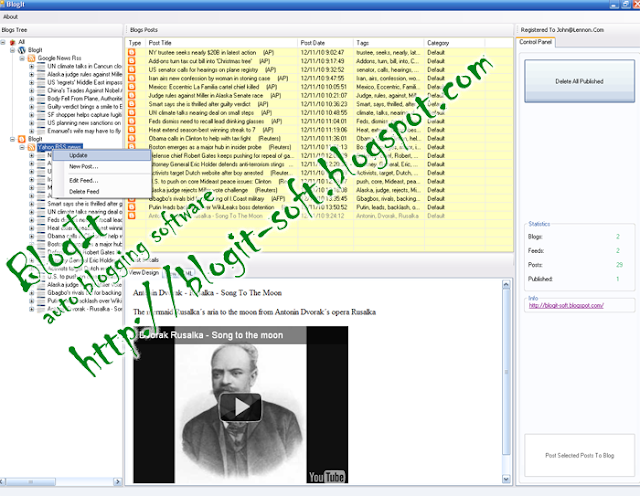
Generated by BlogIt

BlogIt - Auto Blogging Software for YOU!

BlogIt - autoblogging software for YOU

BlogIt - autoblogging software for YOU

Friday, 24 June 2011

Digital Grilled Cheese D9 Poll Results Are In: "The Kara" Edges Out "The Walt"


Personally, I preferred “The Walt” over “The Kara.”


But the attendees of the ninth D: All Things Digital conference seemed to like the grilled cheese sandwich made of “sharp” cheddar more than “experienced” gruyere.


In sampling by hungry D9 folks, 53 percent selected “The Kara” (sharp cheddar on potato bread with tomato basil soup) and 47 percent chose “The Walt” (experienced gruyere on white wheat with wild mushroom soup).


That’s according to founder Jonathan Kaplan, who demoed his new company called Melt.


With Melt, the focus is on grilled cheese, in an unusual mashup of smartphones, automation and comfort food.


You can order with Melt’s mobile app or from the Web and have your grilled cheese choice ready for you when you want it in a minute in his casual, fast-food restaurants.


The first stores open in San Francisco in August, but there are many more to come via many millions of dollars in funding from Sequoia Capital.


Obviously, grilled cheese is a very orthogonal move for Kaplan, who brought the world the ground-breaking Flip video camera.


Bought by Cisco for $590 million in 2009, the networking giant closed the unit down in April and killed the Flip. Kaplan still does not know why, he said onstage.


While I still mourn the Flip, I can say that the grilled cheese is pretty tasty.


Here’s a video of the Melt in action at D9 in a demo by Kaplan, as well as a video interview he did with Katie Boehret at the Science Fair booth at the conference:


[ See post to watch video ]


[ See post to watch video ]


Generated by BlogIt

BlogIt - Auto Blogging Software for YOU!

BlogIt - autoblogging software for YOU

BlogIt - autoblogging software for YOU