Showing posts with label building. Show all posts

Friday, 19 August 2011

Sales Management Credibility - Building Respect As a Motivational Sales Manager


Many sales managers tell me that their salespeople don't meet their expectations. The sales manager pleads, begs and even threatens, but the salesperson just goes through the motions of selling and following through on proposals and sales calls. He or she never really engages in their jobs or careers. The sales manager simply doesn't inspire confidence, credibility or have a firm grip on the performance of their sales team.

I could give you a long list of reasons why sales managers lack respect from their sales team and why their credibility is shot. However, I want to focus on the one problem that I see quite often. The quickest way for a sales manager to lose credibility with their sales team members is their lack of taking decisive action when dealing with poor sales performers.

Too many sales managers, for myriad reasons, fail to address the issues associated with a poor sales performer. They talk about them with other people or managers. They listen to excuses month after month. The sales manager may think changing the salesperson's compensation plan might help or even providing a new territory or product will fix the problem.

Instead, what really happens is the salesperson in questions monopolizes the sales manager's time and energy while the other salespeople shake their heads and shrug their shoulders each night as they go home and download to their spouse. They can't figure out why their co-worker isn't pulling his or her own weight and why the sales manager isn't doing anything about it.

Allowing poor performers to hang out too long simply reinforces poor performance. If no accountability is in place, then why should the poor sales performer step up and make an effort? Empty promises and hollow threats from the sales manager don't mean a thing. The salesperson still collects a paycheck and the rest of the team gets more and more frustrated with the lack of decisive action.

If you have a salesperson that isn't performing, it's your responsibility to take action to find out why and work to resolve it.

Here are just a few reasons why your salesperson is not performing:


Insufficient product training
Lack of effective sales training
Micromanaging sales manager
Lack of leadership in the company
Poor sales hire - they're not "wired" for the job
You inherited a poor sales performer when you started as sales manager
And many, many more...

I'm an advocate for always attempting to first find the source of the lackluster performance and fixing it, if possible. However, if you haven't discovered it through diligent analysis, then your options are reduced to either moving the salesperson to another position in the company or removing them completely.

In either case, your attention to this serious problem is desperately needed on the part of the sales team. It cannot function as a sales team unless you build the confidence of the members that you're right for the job. You must prove that you will make decisions that are in the best interest of the team and have a strong desire to create an environment of success for everyone.

Remember, the viability of your sales team rests on your shoulders. Don't let them down.


Barrett Riddleberger is an internationally recognized leader in the fields of sales skills assessments, custom custom sales training, sales recruitment and sales consulting. He also is founder of Resolution Systems Inc., a strategic sales consulting firm. His book, "Blueprint of a Sales Champion," details how organizations can find, train and retain top performing salespeople... even in a highly competitive market. An accomplished author and sales consultant, Riddleberger is also highly in demand as a business development and motivational speaker for organizations seeking to drive their sales force to greater levels of performance. For more info visit ResolutionSystemsInc.com or call 866.350.4457.


This post was made using the Auto Blogging Software from WebMagnates.org This line will not appear when posts are made after activating the software to full version.

Saturday, 23 July 2011

Building Self-Awareness From Philosophical Literature


One of the primary sources for the formation of individual's self-awareness is in the reflections, whether it concerns situation oriented realizations of one's being, contemporary characteristics displayed in the past, finding similarities in one's own characteristics from others or for example by reading literature. In this article we consider how you can build self-awareness from philosophical literature and the advantages it proposes for you.

Although there is yet to be born the 21st century philosopher with as deep sense of existence and mortality as Friedrich Nietzsche, whose writings echo the passions humans are capable of, placing the reader in contrast with depths only but few in the entire history of mankind has reached, existentialism can be considered as a primarily focusing on the life and characteristics of human existence, thus making it an invaluable source for self-reflections although the further in history the reader exceeds with literature, the less developed forms of knowledge he or she is to encounter. Aristotle the teacher of one of the most horrific military leaders, Alexander, and the supporter of slavery, did such matters as he was as unable escape his time and the state the representational reality existed as any one of us are during the time existence.

When we take note on the fact that none can escape time, but only be timely however revolutionizing we might consider the contemporary philosophies to be in contrast with those of the past, we find how the entire history of philosophy in global level proposes to us an invaluable source of knowledge for self-reflection, varying from the sense of mortality to Machiavellian egotism to passions of Nietzsche to Objectivism of Ayan Rand to formation of Zen mind to contemporary metaphysics (the study of the fundamental principles of existence) and anything in between. Thus, there has not existed a time when the availability of knowledge was as plentiful as it now for any class or race, forming a rich foundation for the individual to develop his or her self-awareness and the sense of existence.

Why? When life, time and existence in general are considered, philosophy has been and will be written by those whose one of the main aims of life has been to deeply contemplate the issues of life, time, and existence, sharing the fruits of their labor in philosophical literature, generating more depth, content and meaning to life for all who contemplate and reflect. Similarly as realizations can alter the individual's sense of reality, learning generate new kind of semantic knowledge to the perception of the environment, so do self-reflections in relativity with philosophical literature alter the foundations of individual's existence, increasing the depth of the roots the sub-conscious draws the emerging thoughts from.

Copyright © 2010 Henry M. Piironen


Henry M. Piironen is the author of "The Power of Transiency (How Thoughts Can Harness the Power of Life, the Universe and Everything)." To purchase this definitive book, visit Amazon Kindle Store now! Already read it? To purchase his other books, click here.


This post was made using the Auto Blogging Software from WebMagnates.org This line will not appear when posts are made after activating the software to full version.

Monday, 4 July 2011

The Basics of Building Facebook Applications


The ubiquity of Facebook is hard to ignore. It started as a local service that helped college students connect and has expanded into a worldwide phenomenon with millions of users accessing Facebook and associated applications every day. The size of the Facebook audience makes it a compelling platform for developers as does the versatility of the site. There are a wide range of applications already being used on Facebook and the possibilities for new applications are limited only to the developer's imagination. So let's discuss some of the basics when it comes to building Facebook applications.

In the Beginning

Any developer who is hoping to write or install Facebook applications must first have his or her own Facebook account and then must install the developer application. Facebook's developer application allows you to create, monitor, and configure applications. In addition, you'll need to secure yourself a server as Facebook applications run form the developer's server. The benefit of this is that you can write the application in whichever language you know best. For the sake of simplicity, examples in this article will use PHP but the process is the same regardless of the language you use.

Once you have your Facebook account, have downloaded the developer application, and have your server ready to go, you'll be ready to start developing your own applications. Still, having a bit of understanding of the Facebook platform will help you during the creative process. First and foremost, the fundamental components of Facebook are clearly outlined on their developer site. Essentially, the platform is made up of three parts: API, FBML, and FQL. Of course, APIs determine the ways in which you can connect to and interact with Facebook. FBML is the custom Facebook markup language which has basically be modeled around HTML. While similar to Coldfusion or ASP.NET and associated tag-based syntax, FBML helps you to define the pages of your application specifically for the Facebook Platform. And finally, FQL is the Facebook Query Language which is also a customized developer language for Facebook that is based on SQL. FQL is especially useful when there are no helper methods in the API but can also be used for tags in FBML giving developers an incredible amount of control over the details of their application.

Facebook Development Tools and Resources

Like any development applications, Facebook features a range of tools and resources that can help developers in a number of ways. Apart from the core documentation, tools can also help you debug raw API calls or tweak the FQL. With Facebook resources you'll find a collection of libraries for PHP and Java as well as links to other libraries like ActionScript, Cocoa, Coldfusion,.NET, Perl, Python, and Ruby. In addition, Facebook has an ever-expanding community wiki that can help answer any questions you may have about the details of developing Facebook applications. Because Facebook is a fairly complicated social media network, pages often feature layers upon layers of detailed information and it is certainly in the best interests of the developer to become familiar with FBML and API. Indeed, FBML and API allow you to manipulate a lot of this information so a more in-depth understanding of these tools and the terminology used on the site. Experienced Facebook users, for example, will know the difference between the News Feed and your Profile page and so should developers.

Step-by-Step Guidelines for Creating an Application

At this point, let's discuss briefly the stages involved in building a Facebook application. Of course you'll need to get the Facebook Developer Application to begin but from here there are some basic principles that should help guide you through the process.

1. To begin setting up a new application select the "Set Up New Application" option in the developer application. You'll want to name your application and you'll also need to accept the Terms of Service. Your API key is used so that Facebook can recognize your application and your application secret are used so that Facebook can authenticate your requests. Choose a secret that is easy to remember and also difficult to hack as you would with any online password.

2. The next step involves configuring a number of settings before starting to write code. Under the "Edit Settings" section you can enter support and contact information, including your email address.

3. A callback URL is required and this would need to be the address where your application is stored on the server.

4. A canvas page URL is also required and this tells us where your application is stored on Facebook. Developers usually want to match their canvas page URL with their application name so that it's easy to remember for users. This URL must be a minimum of 7 characters long and can include only letters, dashes, and underscores.

5. Next, Facebook will ask you whether your application can be added on Facebook, obviously you'll want to say "Yes."

6. To continue developing your application click "Save and Continue."

While these are the most basic steps for creating a simple application, configuring your application to your host still needs to be completed. Nevertheless, experienced developers will find it an extremely straight forward exercise to develop Facebook applications. The process is streamlined and simple so as to encourage the addition of new, interesting, and interactive applications from a broad developer community. Regardless of culture, language, or location applications can be easily uploaded for the enjoyment of the massive Facebook audience.


Moonrise Productions is a full services San Francisco web design company. They offer complete design services, social network web development, ecommerce development, social network hosting and more. With New York, San Diego, San Francisco and a Los Angeles presence no matter where you are, we've got people to serve you.


This post was made using the Auto Blogging Software from WebMagnates.org This line will not appear when posts are made after activating the software to full version.

Sunday, 26 June 2011

Easy link building techniques


easy-link-building

If you spend more than twenty minutes on any of the large webmaster forums, you are likely to find a lot of posts and threads related to link building since this is a great way to improve a site’s search engine placement. Of course, link building is only one part of a successful SEO strategy, but typically gaining a lot of quality backlinks doesn’t cost a penny and requires only time and perseverance.


How can you build backlinks and increase your website traffic for free?


Write an e-book: believe it or not, you don’t have to be a professional writer in order to write a quality e-book that other people would find informative and useful. Almost everyone is an expert in one field or another: find a topic that you know about and that you are passionate about, find what most people want to know about this topic, take the time to do some research, and finally put together an e-book. Make sure that you link to your main site or a few of its pages from within the text and as long as your e-book is of good value, you will soon discover other people linking to your site from their own blogs or forums. You may also submit your eBook to sites like clickbank. That way you do not only increase income potential, but the affiliates will also have to link to your site when they direct their traffic to your money page. This will, of course, strengthen your website in the search engines resulting in even more traffic and customers.


Write articles and submit them to the article directories: there must be thousands of article directories out there that will gladly publish your well-written articles. It is up to you to narrow down the list to a manageable size, then write articles, submit them, and use this as part of your link building and SEO long-term strategy. The top article directories also rank very well on the search engines and if one of your articles starts receiving good amount of search engine traffic, at least some of the people that read it are likely to visit your site as well. Most internet marketers know about do-follow article directories like ezinearticles, articlesbase and isnare which are among the best article sites out there, but too few publish their content on Buzzle. In my experience Buzzle and ezinearticles are the two strongest article directories in terms of ranking the best in Google.


Offer quality content on your own website: the majority of people are getting online when they need to search for information, for a product to buy, or to entertain themselves. No matter what your site is all about, quality content is likely to keep people coming back, but is also a great way of link building: if you have a computer-related blog, write detailed and up-to date article on anti-virus protection, include a few links to the best anti-virus protection software, and you are likely to get dozens if not hundreds of links from various computer forums, blogs, and websites. Search engines are becoming smarter and smarter and if you browse the net you will probably notice that sites with good quality content rank better in the SERPs. As an example there are thousands of article directories on the net, but those that rank the best, like Ezinearticles and Buzzle, are those with the highest quality criteria. Those sites will manually approve your content and proper English is a requirement.


Submit your website link to directories and social bookmarking sites: you might hear people saying that this is an outdated link building technique, but they are wrong. Of course, the search engines give less weight to such links compared to a few years ago, but this is still an easy way of getting quality links and getting direct traffic as well. Don’t get lured by the services that offer sending your link to thousands of directories for just a few dollars: out of these thousands of directories, only a few dozen are actually worth submitting to and you can easily create your own list. Here are a few quality social bookmarking sites I use: stumbleupon.com, digg.com, propeller.com, del.icio.us, reddit.com, folkd.com, diigo.com, mixx.com and newsvine.com.


RSS feed directories: Although utilized by many link builders, it is not commonly known that submitting your site to RSS feed directories is an actual link building technique. Submitting your site to those will indeed help your new post get noticed by the search engines, but many of them actually creates a valid back link too. Sites like feedage.com, rssmountain.com and feedagg.com are high page rank sites willing to link directly to your site.


Link building, however, is more than just knowing how and where to build links it is also important to actually do it the right way. Timing is the keyword. You need links from a variety of sites like directories, blogs, social bookmarking, article sites etc. otherwise big G will regard your efforts as manipulation of SERPs. What I usually do is to build links slow but steady starting with a few social bookmarkings, then a few link directories. Do never use any software to make your job an easier task. Google will know if you have been using software like Onlywire.com. You WILL need to write unique title and descriptions for all your social bookmarks and link directories. If you use blog commenting make sure that the blogs are relevant. The next step is to create blogs and publish articles together with press releases. This technique has the greatest effects if used long term. Do not suddenly stop creating blog / web 2.0 networks, it will seem suspicious in the eyes of Google. Instead slow down your activity for a while before quitting. Here are some do-follow web 2.0 sites I use with high page rank: WordPress.com, Weebly.com, Squidoo.com, Hubpages.com, Blogger.com, Livejournal.com, Vox.com, Quizilla.com and Blinkweb.com. I have also found Yola.com sites to rank pretty well.


SEO strategies change constantly, but this shouldn’t discourage you from looking for new and better ways to build true backlinks to your site and it is almost certain that persistence and hard work will pay off sooner or later.


Guest post by Ronni Rebsdorf


Enhanced by Zemanta


No related posts.


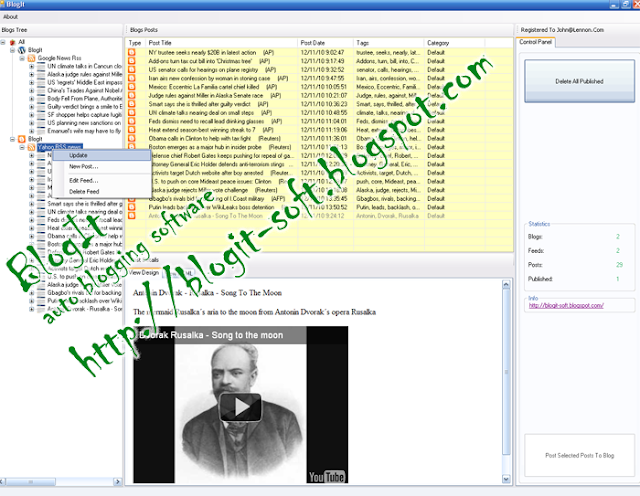
Generated by BlogIt

BlogIt - Auto Blogging Software for YOU!

BlogIt - autoblogging software for YOU

BlogIt - autoblogging software for YOU